
May 16, 2025 · 9 min read
Scuba Diving Travel Health in Ajax: Before Your First Descent
Prepare for a scuba holiday from Ajax with practical guidance on medical fitness, ear problems, dive operators, emergency plans and flights after diving.
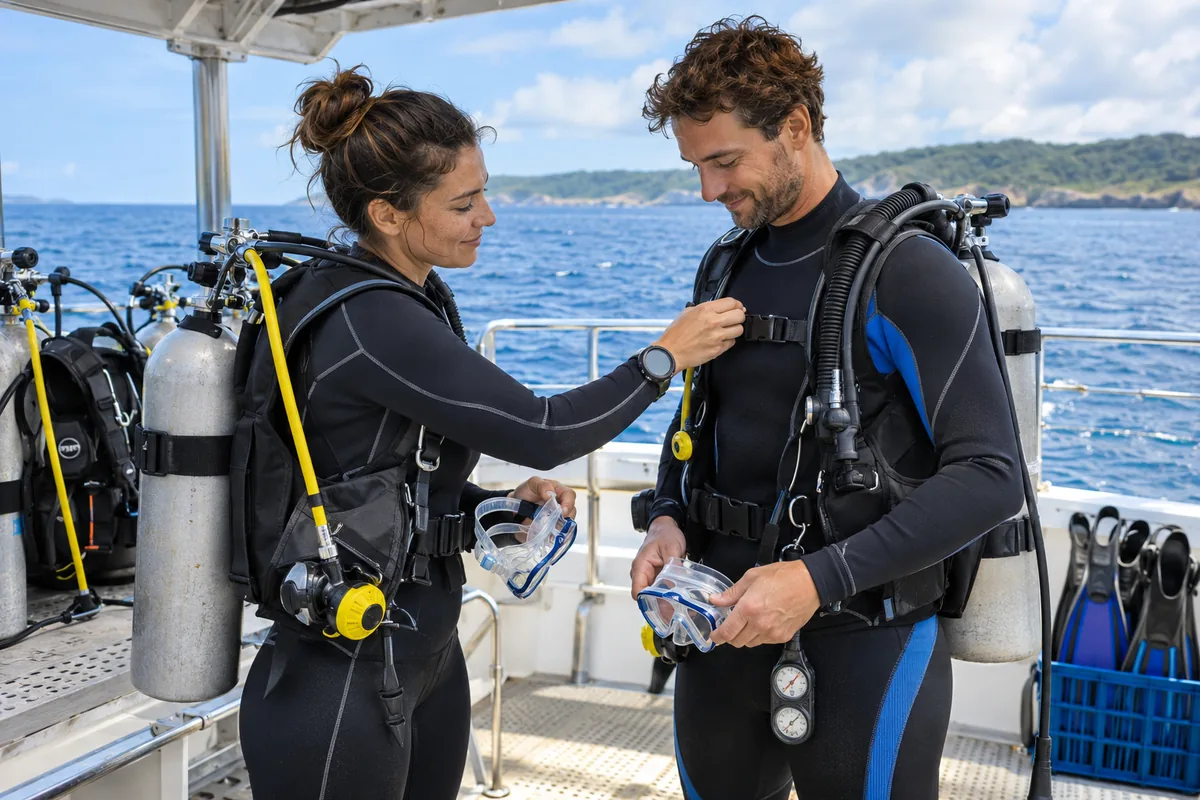
A diving holiday starts long before the boat leaves the harbour. It starts when you decide how many dives to book, choose a flight home, and describe your health honestly on the operator’s questionnaire. Those decisions are easier to make at your kitchen table in Ajax than on a crowded boat with a group waiting for you to enter the water.
Scuba diving travel health in Ajax brings together two kinds of preparation: the ordinary health needs of an international trip and the particular demands of breathing compressed gas underwater. Vaccination records, food precautions, and medication supplies still matter. So do pressure changes, physical exertion, emergency access, and whether your proposed dives fit your training. Give each part enough attention to support the holiday you actually want.
Begin with the real diving itinerary
“A week at the beach” is not a useful description if you intend to spend most mornings offshore. Write down the number of diving days, expected depths, boat travel time, and whether you will stay on land or aboard a liveaboard. Include any training course, wreck visit, night dive, or remote excursion. These details help reveal where additional preparation is necessary.
Separate activities that are already within your training from experiences that require more instruction. A destination photograph cannot show you the current, visibility, entry conditions, or effort needed to climb a boat ladder. Ask the operator to explain those conditions in ordinary language. If the answer depends on the weather, find out which alternative sites they use and how they decide whether to cancel.
Allow room for a missed dive. A schedule that feels worthwhile only if every booking goes ahead makes it harder to sit out when you are unwell. Choosing accommodation with enjoyable activities on land can make a cautious decision feel like an ordinary adjustment rather than the loss of an entire day.
If you are travelling with a regular dive buddy, compare expectations before paying deposits. One person may be imagining relaxed reef visits while the other is hoping to add demanding excursions. Agree that either person can decline a dive without having to justify the decision to the whole group. Discuss how you will spend time together when only one person participates. For a mixed group of divers and non-divers, check boat passenger arrangements, shade, meals, and return times. A shared holiday works more smoothly when the people staying above water have a clear plan too, rather than finding out at the dock that the excursion lasts most of the day.
Treat the medical questionnaire as useful information
Complete the operator’s current medical screening form before making commitments that are difficult to change. Answer accurately about health conditions, surgery, symptoms, and medicines. Some responses require medical evaluation before participation. The Divers Alert Network explanation of health screening describes the role of the diver medical questionnaire and further assessment when needed.
Being comfortable swimming does not establish medical fitness for scuba. Heart or lung conditions, episodes of fainting, certain neurological problems, and other concerns may need specialist consideration. A clinician familiar with diving medicine can assess how a condition interacts with immersion, pressure, and the ability to manage an underwater problem. Bring relevant records instead of relying on a brief verbal summary.
A general travel health appointment does not automatically provide a diving fitness certificate. Ask the dive operator what documentation it requires, then arrange the appropriate assessment if indicated. Start early enough for a referral or additional information from your usual clinician. This avoids placing pressure on anyone to approve an activity immediately before departure.
Make the first day a sensible return to the water
A certification earned several years ago remains part of your training history, but it does not tell an unfamiliar operator how comfortable you feel today. Explain when you last dived and what equipment you used. If your skills feel rusty, arrange a refresher with a qualified instructor. There is little value in hiding uncertainty about a routine procedure that can be practised beforehand.
Consider the practical demands of the boat as well as the underwater activity. Carrying equipment across a jetty, remaining steady on a moving deck, and climbing out in swell can be tiring. Discuss any assistance you need before arrival. The operator can then explain its facilities rather than improvising after the group has departed.
Avoid packing the arrival day with commitments. An overnight flight, long transfer, equipment fitting, and immediate dive can leave almost no time to notice how you are feeling. A quieter beginning gives you space to sleep, eat, organise your belongings, and speak with the staff who will be supervising the following day.
Take ear and sinus discomfort seriously
Ear pain during descent is a reason to stop and communicate with your instructor or buddy. Do not force your way deeper because everyone else appears comfortable. Pressure equalization should be learned and practised through proper instruction. Difficulty equalizing, congestion, a recent ear problem, or persistent discomfort warrants advice before further diving. DAN’s ear equalization guidance explains why early attention matters.
A cold that seems minor on land can interfere with the ability to equalize underwater. Avoid using a decongestant simply to make a dive possible without discussing the situation with a knowledgeable clinician. Medicine can wear off, cause adverse effects, or leave the original problem unresolved. The decision should consider both the illness and the product you intend to take.
Write down previous ear injuries or operations when preparing your medical history. If you have had pain, vertigo, or hearing changes with an earlier dive, describe what happened and whether you received treatment. Those details are more helpful than saying that your ears are “usually a bit difficult.” New hearing loss or significant dizziness requires prompt assessment.
Review medication in the context of the activity
Bring a complete medication list, including nonprescription remedies and supplements, to the appropriate medical review. Ask specifically about products for motion sickness, allergies, sleep, and pain. A medicine that causes drowsiness or affects alertness may matter differently underwater than it does during an ordinary day at home. The underlying condition also needs consideration.
Do not first try an unfamiliar product on the morning of a dive. If a clinician recommends a medication, clarify how you should assess its effects beforehand and what symptoms would mean you should avoid diving. Keep instructions in their original form so that a label or dosage is not reconstructed from memory during travel.
For destination medicines, explain that scuba is part of the trip when discussing options. The same principle applies to your prescription medication travel plan: pack enough supply, keep essential medicines accessible, and confirm storage arrangements. On a liveaboard, ask about secure storage and any temperature requirements before assuming a suitable refrigerator exists.
Look beyond the boat’s photographs
Ask prospective operators about instructor qualifications, equipment servicing, group sizes, and how divers are matched by experience. Request an explanation of the briefing, buddy arrangements, and process for a diver who wants to end a dive. Clear answers are useful evidence of how the day is organised; attractive photographs cannot answer those questions.
Emergency planning deserves equally specific attention. Ask whether suitable first aid equipment and emergency oxygen are available, who is trained to use them, and how the boat contacts medical assistance. Find out what happens if communication fails or weather delays the return. The important issue is the working plan from that particular site, not simply whether a hospital appears on a map.
Discuss insurance directly with your insurer. Describe recreational diving, training, planned depths, and any specialist activities accurately. Confirm provisions for emergency treatment, evacuation, and any required certification. Keep the written response with your policy documents. A general holiday policy may have activity conditions that are easy to miss when comparing only the purchase price.
Recognize illness after a dive
Unusual joint pain, numbness, weakness, difficulty walking, breathing trouble, or other new symptoms after diving need urgent medical attention. Symptoms can have more than one cause, and a reassuring dive computer does not rule out a diving injury. The CDC overview of dive-related injuries describes decompression illness and the importance of prompt assessment.
Alert the crew or your companion immediately. Contact local emergency medical services for serious or suspected decompression illness, then seek specialist diving medical assistance. Trained responders can provide emergency oxygen when available. Do not return underwater to try to treat yourself, and do not continue the diving itinerary while waiting to see whether symptoms disappear. DAN emergency assistance guidance explains the order of contacting emergency services and obtaining diving advice.
Make the relevant information easy to retrieve. Save dive logs, computer data, times of symptom onset, and details of any first aid. A companion can help gather these without delaying care. If symptoms improve, still report what happened; improvement alone does not establish that it is safe to dive again or board a flight.
Put the flight home on the diving calendar
Flying too soon after diving increases decompression sickness risk. DAN recommends a minimum surface interval of 12 hours after a single dive within no-decompression limits and 18 hours after multiple dives or multiple diving days. These recommendations apply to divers without symptoms, and longer intervals offer additional protection without eliminating risk. Dives requiring decompression stops need a longer, individually considered interval. See DAN’s flying after diving recommendations.
Calculate the actual hours between surfacing and the flight, not just whether the tickets show different dates. An afternoon dive followed by an early morning departure can leave less time than expected. Discuss the schedule with your operator and follow any more conservative advice or applicable policy conditions. A planned day on land can make the return journey easier to organise.
Include mountain excursions and road transfers that climb to altitude in that conversation. The relevant pressure change is not limited to aircraft. If you feel unwell after diving, do not fly or travel higher while trying to fit around a booking; obtain medical advice. Health concerns take priority over the surface interval calculation for an otherwise well diver.
Keep the rest of the holiday in view
Bring sun protection, drinking water, and clothing suitable for the boat, and ask how meals and safe water are provided on longer excursions. Organise a dry place for medicines, contact information, and a charged phone where practical. These ordinary details are easier to forget when equipment lists are dominated by fins, regulators, and underwater cameras.
For a travel health consultation, bring the destination itinerary, vaccine history, medication list, and diving schedule. Explain whether your plans involve malaria risk, remote islands, or several countries. Review the broader destination risks alongside any separate diving medicine assessment. Good preparation leaves you with clear decisions before departure and enough flexibility to enjoy the water within your training, health, and comfort level.